
The Concept
Survey data cleaning is one of those jobs that matter enormously yet remains largely manual, and often a little messy! By the time a project reaches cleaning, teams are under pressure, fieldwork has moved on, and nobody wants to spend days buried in spreadsheets working out which cases to keep, which values to query, which open-ends need coding, and which fixes should actually be implemented.
This is exactly the kind of work our survey data cleaning agent handles.
This is not a chatbot giving generic advice about outliers or missing values. It is an agent with its own workspace that reads survey files, reviews duplicates and interview status, translates and codes open-ends, flags missing-data issues, prepares callback sheets, writes cleaning logs, and turns approved decisions into reproducible Stata code.
The value is not just that it spots issues. It carries the work forward in a structured, auditable way.
The agent starts with the case review layer: duplicates, re-interviews, status problems, and the set of cases that should stay in the working database. It then moves into deeper case-level cleaning by flagging impossible values, suspicious outliers, inconsistent roster relationships, missing fields, and open-end responses that need translation or back-coding. Instead of leaving those findings scattered across notes and spreadsheets, it organises them into a proper review log with proposed actions.
It also takes care of the tasks that can really eat up time. It translates open-ends into English, groups similar responses, and suggests automatic recoding where responses clearly belong in an existing category. Where field follow-up is needed, it automatically develops the callback sheets with the contact details and information required for recontact. It also reviews missing-data problems and distinguishes between values that should remain missing, values that should be confirmed, values that can be derived from other information in the case, and values for which imputation can be employed to support the cleaning process.
Those actions sit together as part of the same workflow: AI suggests the likely next step, the human reviews and confirms it, and only then does the agent implement the approved change. That applies whether the issue is a recode, a callback, a retained missing value, or an imputation.
Human in the loop: how the workflow runs
The agent does not silently rewrite survey data and hand back a black box. It follows a defined workflow with explicit human checkpoints.
It first reviews the database structure and the case universe. It then produces a cleaning log that records the issue, the evidence, and the proposed action. Where field confirmation is needed, it prepares the callback sheets automatically. Where recoding or imputation is appropriate, it proposes those actions clearly for review. Once those actions are confirmed by the human team, the agent writes the Stata do-files, applies the approved corrections, and produces the cleaned outputs with a traceable audit trail.
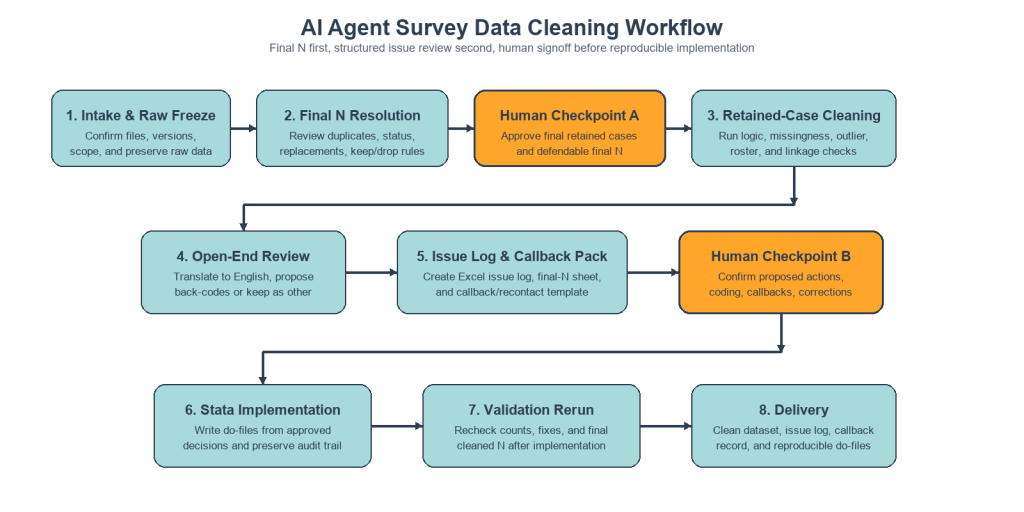
That human-in-the-loop structure is important because survey cleaning is rarely just a technical exercise. A duplicate case may need to be dropped, archived, or retained. An extreme numeric value may be real, or it may need confirmation. An “other specify” response may belong in an existing category, deserve a new one, or stay as other. A missing value may remain missing, be resolved through callback, be derived from other information, or move into imputation review. The agent does the heavy lifting, but the substantive decisions stay visible and reviewable.
The last step is reproducibility. Cleaning should not end as a pile of manual spreadsheet edits that no one can reconstruct a month later. Once decisions are approved, the agent writes the Stata do-files that implement them properly, preserve the audit trail, and generate a cleaned dataset that is easier to defend and easier to reuse.
That is the role of this agent: not replacing statisticians or data managers, but acting as a persistent operator that takes on the time-consuming parts of survey cleaning and pushes them forward in a disciplined and structured way.
Looking for pro bono pilot partners
I am currently looking for organisations with survey data that needs cleaning — especially in national statistics or international development projects — who would like to explore a pro bono pilot of this approach.
If your team is dealing with duplicate resolution, open-end coding, missing-data review, callback preparation, imputation decisions, or reproducible cleaning scripts, I would be keen to talk. You can reach me at info@impactengines.ai.
Impact Engines builds practical AI tools and workflows for data collection, quality control, cleaning, and analysis in the not-for-profit and international development sectors. If this pilot sounds relevant to your team, get in touch.